Talking Horses
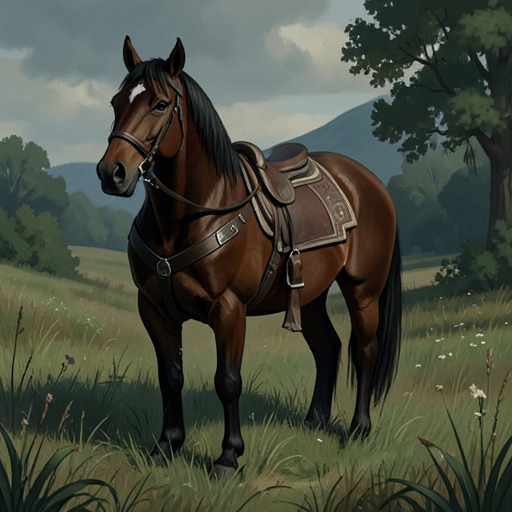
The Horse and His BoyTalking Horses are articulate, self-aware horses whose capture and enslavement in Calormen have separated them from Narnia, their home and desired destination. Through Bree and Hwin, their contrasting temperaments and shared escape, the book makes their struggle for freedom more than a journey between countries: it is also a recovery of identity and the ability to act without a human master directing them.
Identity and Origins
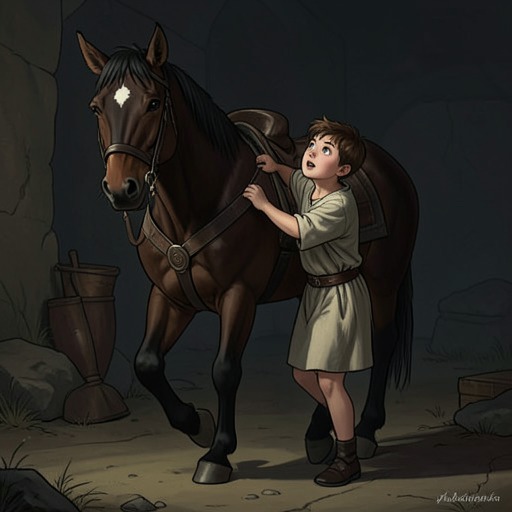
Bree explains that he was captured as a foal after ignoring his mother’s warning not to wander the southern slopes toward Archenland and beyond. He has spent years in human service, concealing his nature and acting as though he were an ordinary, unintelligent horse. His account gives the condition of a Talking Horse two sides: Bree remembers a homeland he loves, while his captors see only an animal they can own and use.
His silence is a deliberate means of survival. Bree judges that discovery would not have freed him: humans might instead have displayed him at fairs and guarded him more carefully, removing his chance to escape. His choice to hide his speech therefore reflects the constraints of captivity, in which revealing the truth about himself could make escape even less possible.
For Bree, Narnia is not an abstract refuge but a homeland he remembers and longs to rejoin. He names its mountains, downs, rivers, forests, caves, and Dwarfs’ hammers, and measures its worth against his years in Calormen. His language turns the thought of home into a contrast between belonging and enslavement, and explains why reaching Narnia matters to him beyond the practical hope of getting away.
Escape and Recognition
Bree’s concealed identity becomes visible during the escape across the water with Shasta. After the horses reach the far beach, Bree blocks the other horse’s way and addresses her as a Talking Horse like himself. The challenge brings Hwin’s identity into the open; Shasta also recognizes that her apparent male rider is a girl, Aravis, wearing her brother’s armor.
Hwin resists the suggestion that her escape is merely Aravis’s affair. She insists that leaving is her own undertaking too: she and Aravis are trying to reach Narnia. Her insistence establishes her as a participant with a purpose, not simply a mount accompanying a human fugitive. When Bree assures her that he and Shasta are bound for the same country, the two horses’ separate escapes become part of a shared journey.
Bree and Hwin’s different manners shape their partnership. Bree is confident enough to interrogate newcomers and to speak authoritatively about travel; Hwin is gentle and hesitant, but she asserts her right to decide what happens to her. Their shared destination does not erase this difference. Instead, Hwin’s quieter interventions repeatedly expose limits in Bree’s confidence.
Freedom and Self-Command
Once the travelers are free of their human masters, the habits imposed by slavery do not disappear at once. During the difficult desert journey, Hwin says she feels unable to continue, but wonders whether the horses ought to be able to make themselves go on now that they are free. She connects the effort to their destination: it is for Narnia. Bree answers dismissively, claiming greater knowledge of campaigns and forced marches.
The narrator confirms the weakness in Bree’s response: Hwin is right that pressure could make him continue, and that enforced labor can leave a captive less able to compel himself once the external force is gone. Freedom, in this account, is not an instant cure. Without a master to order him onward, Bree has to confront a lost capacity for self-direction; Hwin recognizes that freedom also brings the responsibility to choose and persist.
Return and Narnian Custom
After the fighting at Anvard, the Hermit watches his pool and sees that Shasta survives and is greeted affectionately by King Lune. He cannot hear what is said, and stops watching once the battle ends and conversation begins. The following morning, Hwin, Aravis, and Bree consider their next step. Hwin, tired of staying at the Hermit’s home without exercise, proposes going on to Narnia; Aravis first wants to see Shasta and apologize.
The reunion with Cor prompts Bree to set out for Anvard immediately. He and Hwin are to cross into Narnia the next day, while all four travelers leave the Hermit with thanks and a promise to visit again. On the road, Cor explains a custom that surprises the horses: except in war, people in Narnia and Archenland do not mount Talking Horses. Their journey ends not simply in a change of territory but in entry into a society that treats them differently from their former human owners.
That new custom unsettles Bree as much as it reassures him. He becomes increasingly nervous at the prospect of making mistakes because he knows little about Narnian ways. Cor tells him that the humans will learn reading, writing, heraldry, dancing, history, and music, while Bree will be free to gallop and roll on Narnian hills. Bree worries that Talking Horses may not roll, a concern Hwin brushes aside: she plans to roll regardless. The exchange leaves Bree still self-conscious, but places his anxiety beside Hwin’s uncomplicated willingness to act as herself.
Narrative Significance
Bree and Hwin show that escape has both a political and a personal dimension. Their human captors suppress their freedom by treating them as property; Bree’s concealment protects his chance to flee, while Hwin’s insistence that her escape is her own gives voice to a horse’s independent stake in the journey. Their arrival in Narnia promises not merely release from human control but a different social relationship, embodied in the rule against riding Talking Horses in peacetime.
Their differences also give the account of freedom a practical edge. Bree can describe the homeland he misses and reason shrewdly about the dangers of discovery, yet his years of compelled service have weakened his ability to direct himself. Hwin, often the more hesitant speaker, recognizes that freedom requires effort and refuses to let Bree’s certainty decide her part in the escape. Their story thus pairs the recovery of a home with the harder recovery of choice.